
7 Best Third-Party Tested Peptide Suppliers in 2026

Most peptide buyers discover the COA is fake after the vial arrives. Batch testing claims are easy to make and hard to verify, so researchers end up comparing suppliers on trust instead of evidence.
This guide breaks down what independent lab testing and COA transparency should actually look like, then ranks seven suppliers, including Kovagen, against those criteria. You will finish with clear standards for purity, shipping, and research-use compliance, plus a defensible number one pick.
What to Look For in Third-Party Tested Peptide Suppliers
Selecting a trustworthy peptide supplier in 2026 hinges on verifiable testing, transparent documentation, and regulatory compliance. Without those three pillars, a low price or a polished storefront means very little for research integrity.
Third-party testing is non-negotiable because it is the only way to confirm that what is printed on a label matches what is actually inside the vial. An in-house result tells you what a vendor wants you to see. An independent result tells you what is true.
Documentation matters just as much as the testing itself. A certificate of analysis (COA) that cannot be matched to a specific batch, or that is hidden behind a login wall, offers limited assurance. Researchers should be able to pull up the exact COA for the lot they received, on demand.
The factors below form the backbone of any serious vendor comparison. This section details the key areas researchers should assess, including independent laboratory testing, purity standards, shipping reliability, and research use only (RUO) labeling. Each one is a filter that separates credible third-party tested peptide suppliers from vendors coasting on marketing claims.
Independent Lab Testing and COA Transparency
The cornerstone of a reliable peptide supplier is testing performed by an independent laboratory, not an in-house facility. Independence eliminates conflicts of interest and ensures the results are unbiased.
A proper certificate of analysis should contain several specific elements. If any of these are missing, treat the document as incomplete.
- HPLC purity percentage from high-performance liquid chromatography analysis
- Mass spectrometry confirmation verifying the molecular weight matches the expected peptide
- A clear batch or lot number that ties the COA to the vial in hand
- The name and credentials of the testing laboratory, not just the vendor
Accessibility is the next test. COAs should be retrievable by batch number without requiring an account, a password, or a customer service request. A vendor that makes verification frictionless is signaling confidence in its peptide quality assurance.
Finally, look at the lab itself. ISO 17025 accreditation is a widely recognized benchmark for testing and calibration competence. A supplier that works with accredited labs, and says so openly, is typically more serious about sourcing transparency than one that keeps lab details vague.
Purity Standards, Shipping, and Research-Use Compliance
Purity claims must be backed by analytical data, and shipping conditions must preserve peptide integrity from dispatch to delivery. A 99% claim without an HPLC chromatogram to support it is just a number.
For research peptides, 95% purity is generally the accepted floor, while higher-end suppliers reach 98 to 99% or above. Researchers should compare stated purity against the COA figure, not the product page headline. Any gap between the two is worth questioning.
Shipping affects stability in practical ways. Lyophilized peptides are relatively stable at room temperature for typical transit windows, but temperature controls become important for longer routes or extreme climates. Once a peptide is reconstituted with bacteriostatic water, cold chain logistics and insulated packaging matter far more.
Regulatory compliance is the other half of the equation. Reputable suppliers label products research use only and state clearly that they are not for human or veterinary use. Vague or missing disclaimers are a red flag, and awareness of FDA warning letters in the space helps researchers spot vendors with compliance problems.
Reliability rounds out the picture. Look for shipment tracking, responsive support, and consistent lot numbers across orders. These small signals separate dependable US-based suppliers from operations that disappear after checkout.
1. Kovagen (KOVA) - Best Overall
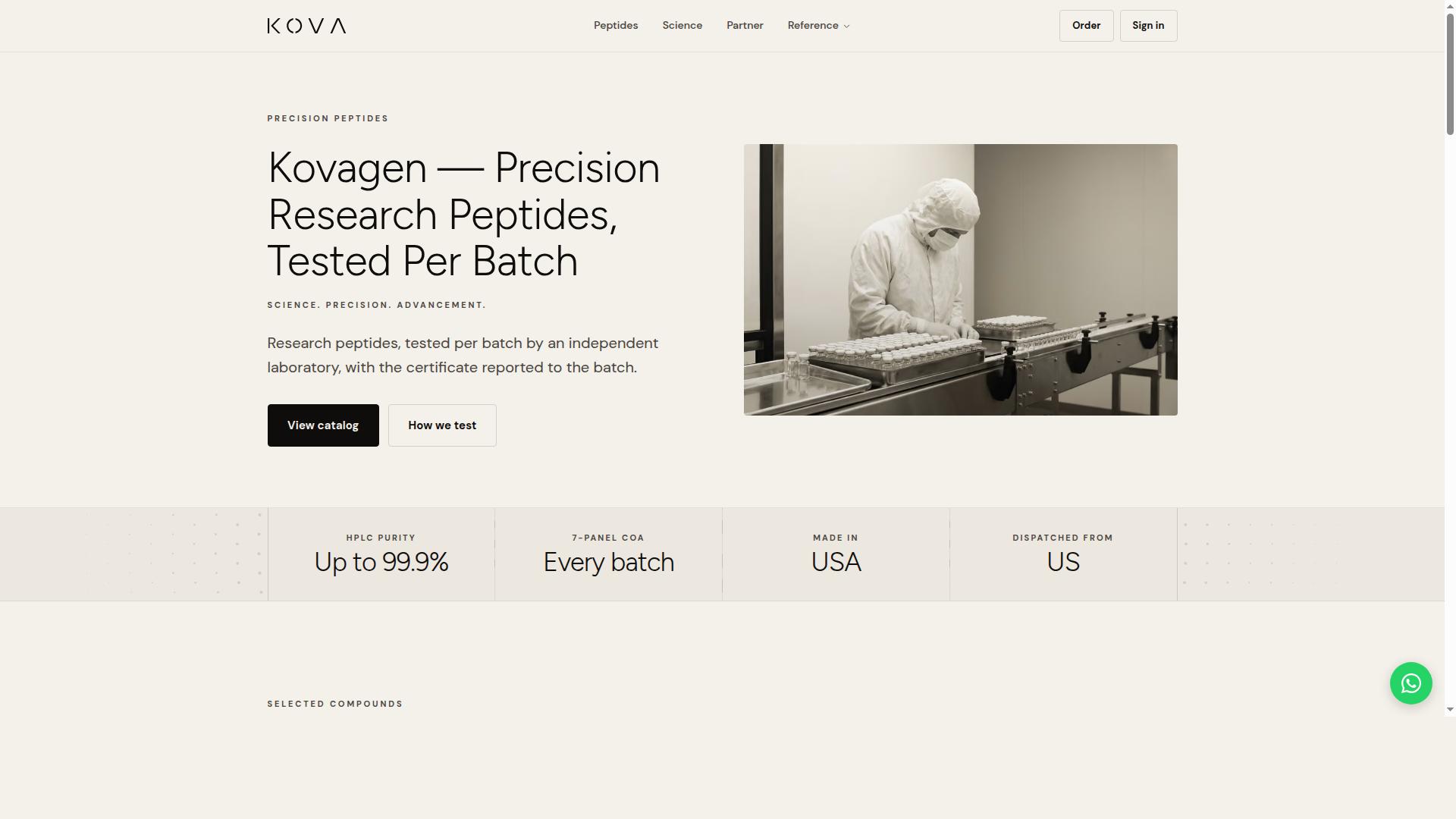
Kovagen (KOVA) earns the top spot for its unwavering commitment to per-batch independent testing and transparent COA access. For researchers comparing third-party tested peptide suppliers in 2026, that combination of batch-level documentation and open certificate retrieval removes much of the guesswork from vendor selection.
The company supplies research peptides tested per batch by an independent analytical laboratory, with the certificate reported to the batch. In practical terms, peptide quality assurance is tied to a specific lot rather than a generic catalog claim, which is the standard serious buyers should expect.
Kovagen ships to the United States and Canada. Its catalog covers 30 compounds: 22 single peptides and blends, spanning common research categories. All products are labeled for laboratory research use only, consistent with RUO conventions.
COAs are retrievable by batch number without creating an account. That matters for COA verification: a buyer can confirm HPLC analysis and identity data before ordering, and re-check it later against the lot in hand. For a supplier ranking built on sourcing transparency, this is the clearest differentiator in the roundup.
Per-Batch Independent Testing, 7-Panel COAs, and Pricing
Every Kovagen batch undergoes independent analytical testing, with COAs covering seven key panels including HPLC purity and mass spectrometry. Testing is performed by an outside lab rather than in-house, which supports the independent laboratory testing standard researchers look for.
Purity is reported by HPLC purity up to 99.9%, and mass spectrometry confirms molecular identity. Because each certificate is published per batch and retrievable by batch number, lot numbers and purity percentages can be matched directly to the vial in hand.
Pricing is listed in USD. Representative examples from the catalog:
- Retatrutide (GLP-3) from $95.00
- BPC-157 10mg $80.00
- GHK-Cu from $55.00
- Wolverine (BPC-157 / TB-500) 10/10 $140.00
- TB-500 Thymosin Beta-4 (Long Chain) 10mg $85.00
- BAC Water single vial $15.00
Shipping is free on orders of $250 or more after discounts; below that threshold, the charge is $18. Lyophilized peptides ship as standard, and bacteriostatic water is available as a separate line item for reconstitution workflows.
For vendor comparison, the useful takeaway is structure: a defined catalog, per-batch certificates, and published prices make side-by-side evaluation against other US-based suppliers straightforward without relying on marketing claims.
2. Core Peptides
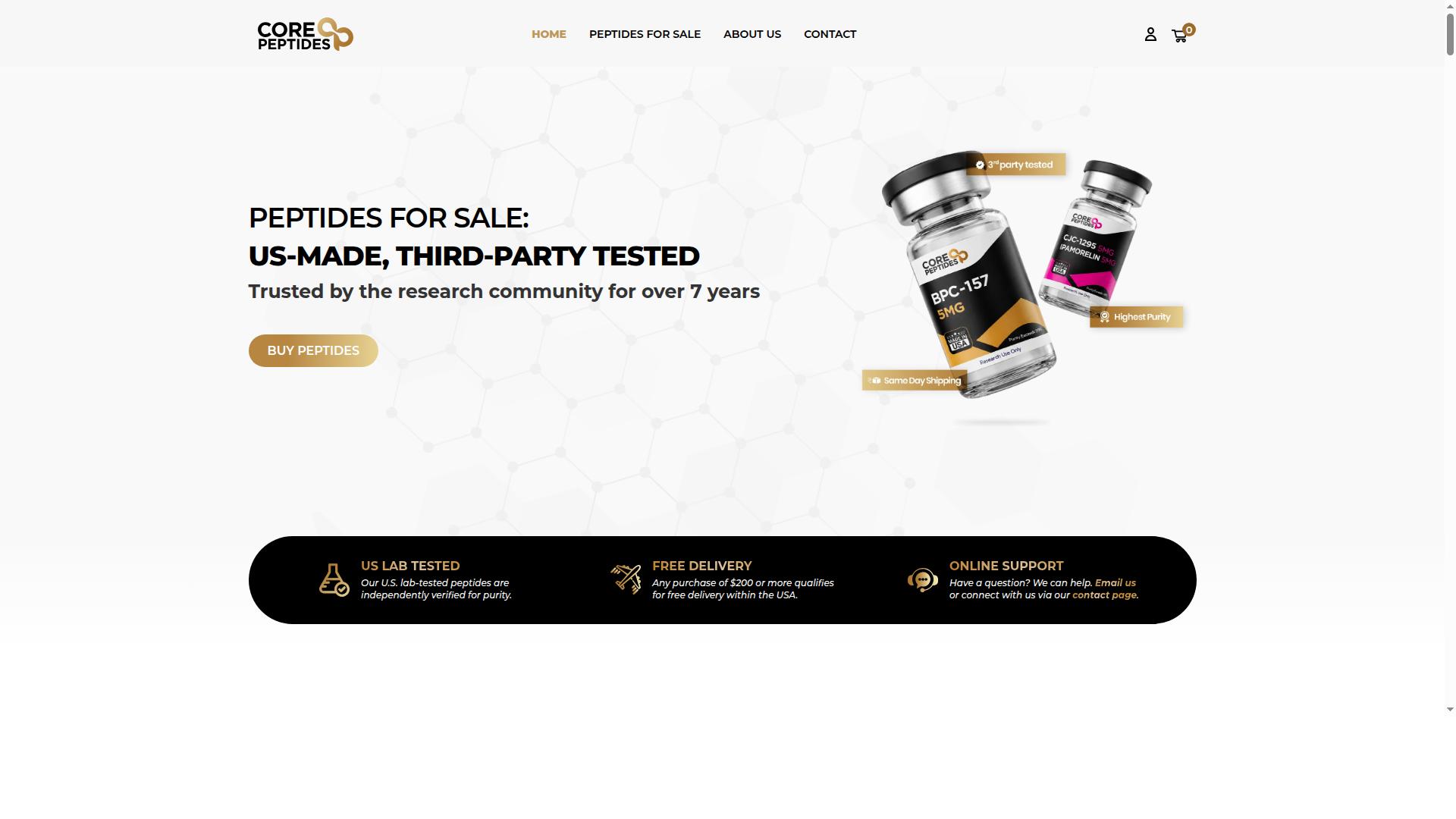
Core Peptides is a well-known supplier that offers a range of research peptides with third-party testing documentation. Its catalog covers common research compounds, and the company is generally associated with providing certificates of analysis for the products it lists.
For many researchers, that documentation is the starting point of COA verification. A certificate of analysis should show the testing method, such as HPLC analysis or mass spectrometry, along with a batch or lot number that matches the vial in hand. Documentation that cannot be tied to a specific lot is difficult to use in peptide quality assurance records.
Core Peptides may appeal to researchers who want an established supplier with a broad catalog rather than a narrow, specialized menu. A wider range can simplify sourcing when a study calls for several research peptides from one vendor. That convenience is worth weighing against how current and complete the supporting documents are.
Because supplier practices change, treat any prior experience as a starting point, not a guarantee. Before ordering, confirm directly with Core Peptides that a certificate of analysis is available for the exact lot you would receive. It is also worth asking about shipping reliability, packaging, and any handling notes for lyophilized peptides.
- Ask whether the COA covers the current lot, not an earlier batch.
- Check that testing methods and purity percentage are stated on the document.
- Confirm RUO labeling and that products are marked for research use only.
- Verify shipping timelines and packaging details before purchase.
In a supplier ranking built on sourcing transparency, Core Peptides holds a credible place as a recognizable name. Researchers comparing vendors should still run their own vendor comparison against each supplier's current documentation rather than relying on reputation alone.
3. Swiss Chems
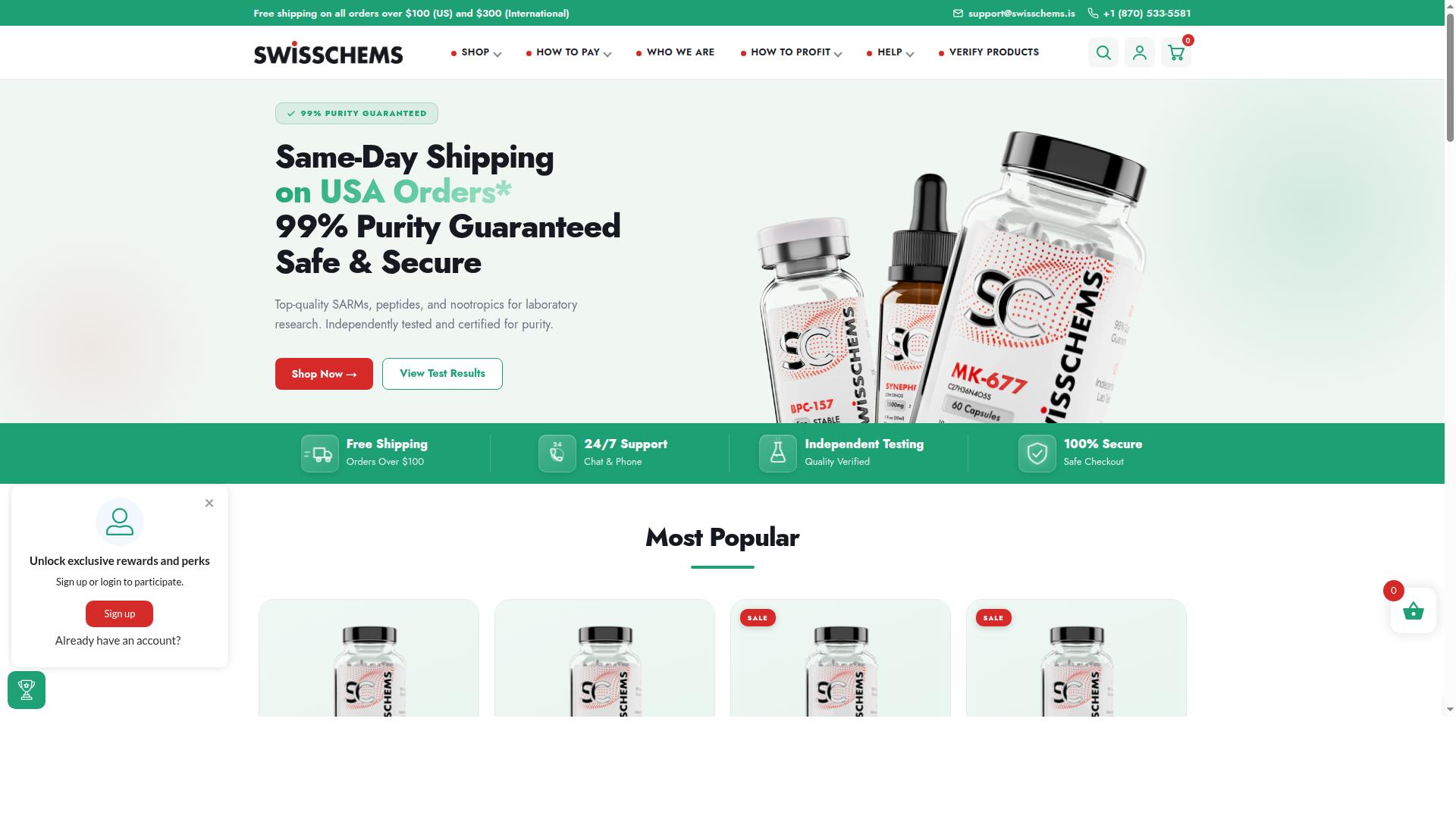
Swiss Chems is another supplier in the research peptide space, known for offering a variety of compounds with testing documentation. It appears on PepVendors, a price comparison platform, with a catalog of 21 peptides, 20 of which overlap with other vendors on that list. That overlap makes it a useful reference point when comparing suppliers on price and available purity data.
The catalog covers well-known research compounds such as BPC-157, CJC-1295, DSIP, Epithalon, GHK-Cu, TB-500, and Thymosin Alpha-1. All are sold as research-use-only products, so buyers should treat labeling and documentation as part of the evaluation. The range is broad enough to suit laboratories comparing multiple compounds from a single source.
Public records show four third-party purity results on file: three from Finnrick and one from Peptigrity. These include BPC-157 at 99.8% (Finnrick) and Melanotan II at 99.7% (Peptigrity). A small set of published results is a starting point, not a guarantee, so confirm the COA for the exact batch you receive.
Example listed prices include BPC-157 10mg at $59.95, TB-500 10mg at $42.36, CJC-1295 20mg at $429.50, and Thymosin Alpha-1 500mg at $639.90. Prices vary by compound and size, so compare cost per milligram rather than sticker price alone.
Before ordering, researchers should take a few verification steps:
- Request the batch-specific certificate of analysis and match the lot number to the vial.
- Check that the COA includes HPLC analysis and mass spectrometry results, not just a purity percentage.
- Confirm the testing lab is independent and named on the report.
- Review shipping reliability and handling details, since lyophilized peptides still require sensible storage.
Swiss Chems suits laboratory researchers comparing vendors on price and purity data. Treat the published results as a screening tool, and verify each batch before use.
4. Ascension Peptides
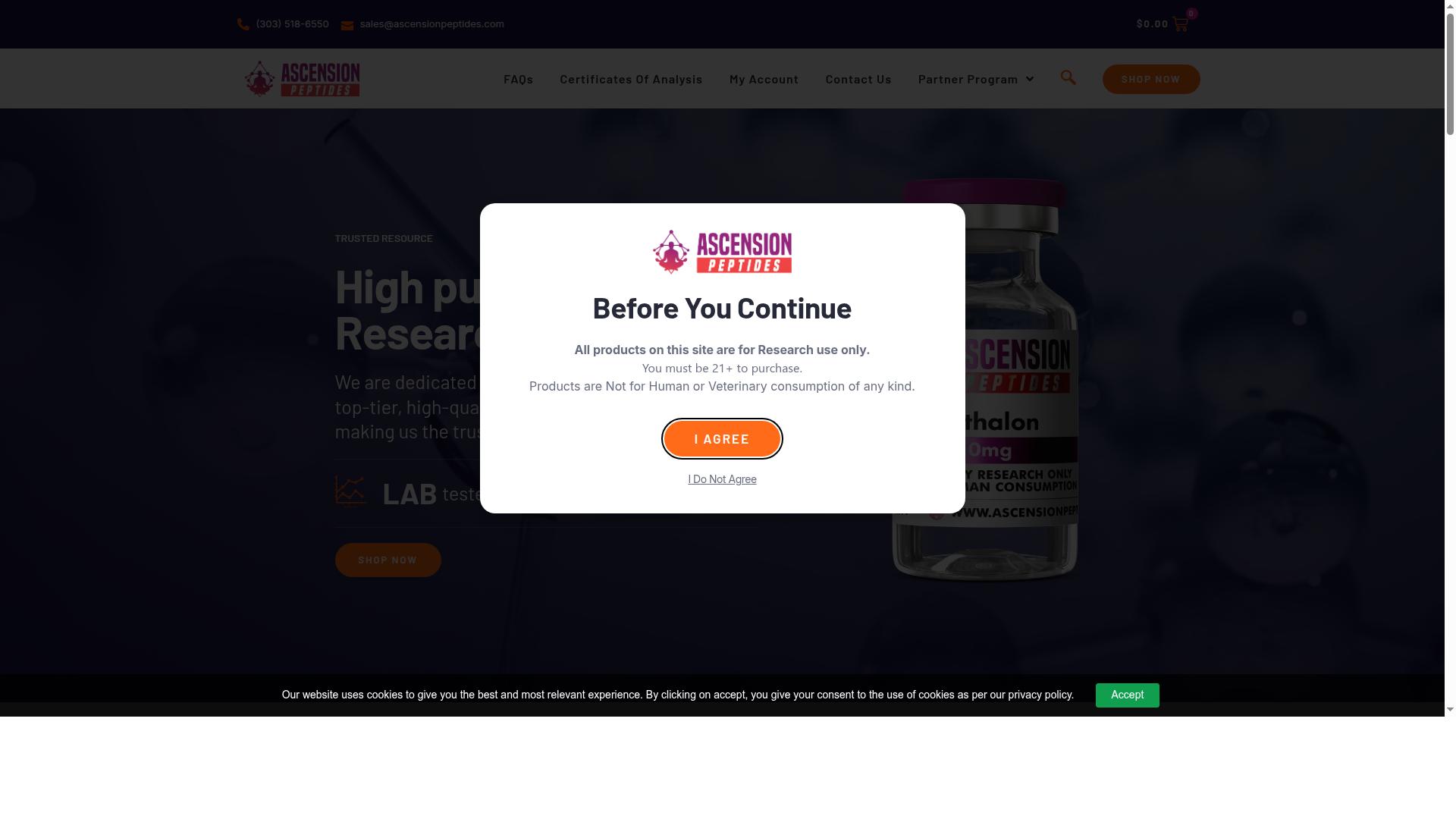
Ascension Peptides markets research peptides with an emphasis on quality and testing, though details vary by batch. The company is a US-based provider specializing in highly purified research peptides, sold strictly for research and development use. Its site carries a 21+ age gate and clear RUO labeling stating the products are not for human consumption.
For researchers who prioritize COA verification, Ascension offers a notable feature: a comparison page citing 85 lot-searchable certificates of analysis. Labs are named per batch, with Kovera Labs and MZ Biolabs referenced in its materials. That level of lot-level searchability is worth checking directly against the batch you intend to order.
Pricing is published for some items. Sale prices include BPC-157 (10mg) at $49.00 and VIP (10mg) at $80.00. Shipping is US-only, so international researchers will need to look elsewhere. The company does not publish a legal entity name or physical address, which is a transparency gap worth weighing in any vendor comparison.
Before ordering, confirm a few practical points:
- Request the certificate of analysis for your specific lot number and check that HPLC analysis and mass spectrometry results are included.
- Confirm which independent laboratory performed the testing and whether it holds ISO 17025 accreditation.
- Ask about shipping timelines, packaging, and how lyophilized peptides are handled in transit.
- Test customer service responsiveness with a pre-sale question about batch testing or purity percentage.
As with any supplier, treat published purity claims as a starting point rather than a guarantee. Verify testing practices independently, and compare COA details against the batch you receive. Shipping reliability and support responsiveness are practical factors that only show up after you engage with a vendor, so factor them into your supplier ranking alongside documentation quality.
5. Verified Peptides
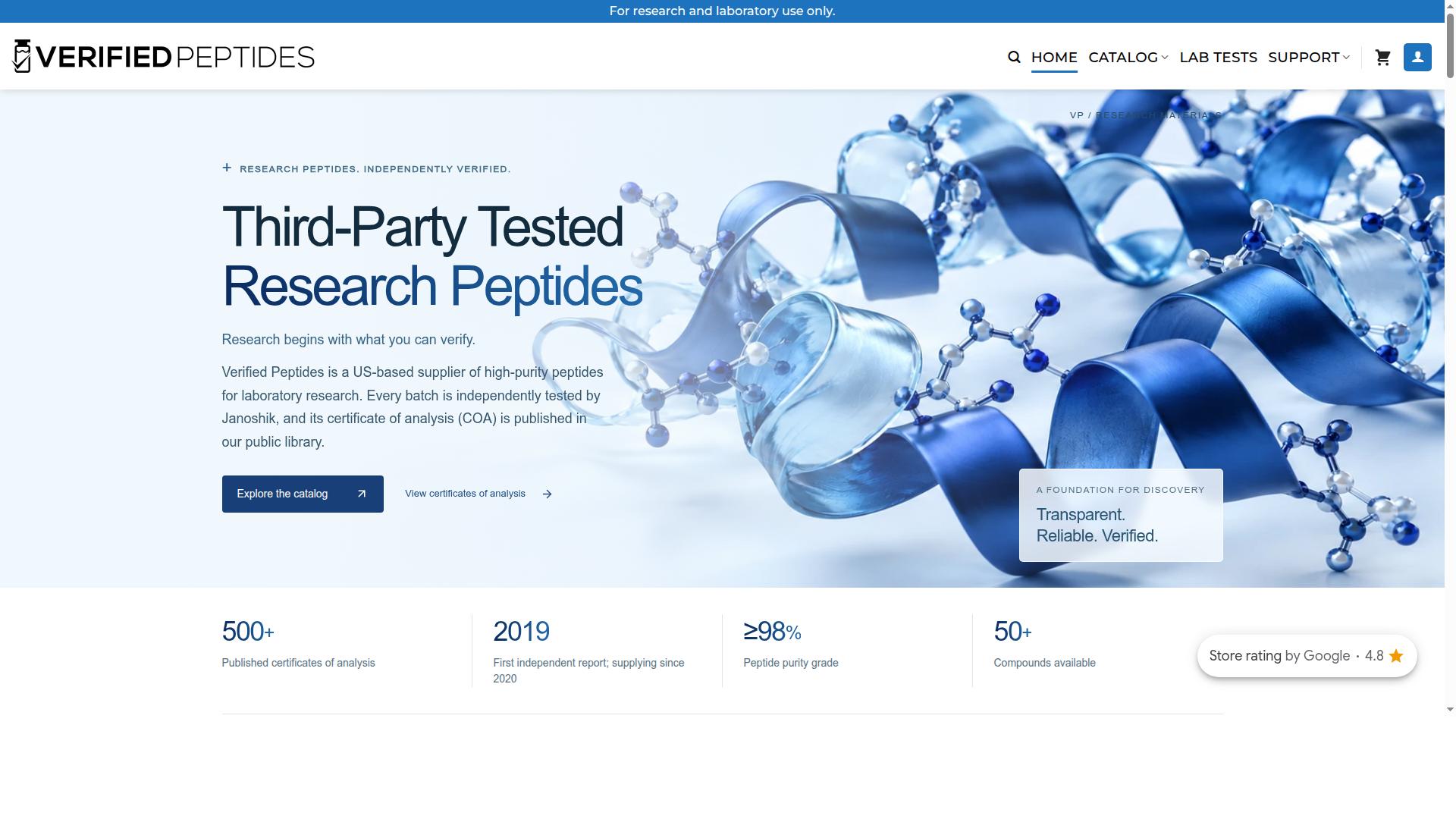
Verified Peptides positions itself as a supplier with a focus on testing and documentation, but researchers should scrutinize the specifics. The name signals an emphasis on verification, yet a label alone does not confirm that independent laboratory testing has actually occurred. Buyers comparing third-party tested peptide suppliers in 2026 need to look past branding and examine the underlying evidence.
At a general level, the company is understood to offer research peptides and may provide third-party testing documentation on request. That places it in the same broad category as other vendors that publish analytical results alongside their catalog. The key question is whether those documents are batch-specific rather than generic reference sheets.
When reviewing any supplier in this tier, keep the following checks in mind:
- Confirm that the certificate of analysis matches the exact lot number on the vial you receive.
- Verify that the testing laboratory is genuinely independent, not an affiliate of the supplier.
- Check whether HPLC analysis and mass spectrometry results are both reported.
- Look for a purity percentage stated on the COA rather than a vague "high purity" claim.
- Ask whether the lab holds credentials such as ISO 17025 accreditation.
COA verification is where many research peptide buyers get tripped up. A polished document can still be recycled across batches, so cross-referencing lot numbers is essential. If a vendor cannot or will not connect a COA to a specific batch, treat the documentation as unconfirmed.
Because public information about Verified Peptides is limited, this entry should be read as a starting point rather than an endorsement. Researchers should request batch-specific documentation directly, confirm the independence of the testing lab, and compare the depth of evidence against other suppliers on this list. In a crowded field of third-party tested peptide suppliers, verifiable documentation matters more than a name that implies it.
6. Blank Peptides
Blank Peptides is a supplier that offers research peptides, with testing documentation available for some products. Because the public record on this vendor is thin, buyers should treat it as a starting point for their own due diligence rather than a finished verdict.
Before ordering, confirm which products carry a certificate of analysis and whether that document comes from an independent laboratory. A COA that lists HPLC analysis and mass spectrometry results, along with a lot number that matches your vial, tells you far more than a generic purity claim on a product page.
It also helps to check how the supplier handles the practical side of an order. Review shipping timelines, packaging for lyophilized peptides, and whether support responds to pre-sale questions in a reasonable window. A vendor that answers testing questions clearly before a purchase is usually easier to work with afterward.
- Ask for a sample COA and confirm the lot number matches the product you receive.
- Check whether purity results come from an independent lab or an in-house test.
- Confirm RUO labeling and research-use-only language on the product page.
- Test customer support response time before placing a first order.
None of these steps guarantee quality on their own, but together they give you a clearer picture of sourcing transparency. If documentation is missing or vague, that is useful information too. Buyers comparing vendors in 2026 should weigh Blank Peptides on the same criteria as every other name on this list: verifiable testing, clear labeling, and dependable fulfillment.
7. PSPeptides

PSPeptides is another option in the research peptide market, offering a range of compounds with varying levels of documentation. Unlike suppliers that publish detailed testing records upfront, PSPeptides is best approached with a verification-first mindset. Buyers should treat it as a starting point for research rather than a confirmed third-party tested source.
At the time of writing, publicly available information about PSPeptides is limited, so this entry stays deliberately general. That is not a criticism of the supplier. It simply means readers need to do their own diligence before ordering.
Before placing an order, confirm the following directly with PSPeptides:
- Certificate of analysis availability for the specific batch you would receive, not a generic sample COA
- Whether testing was performed by an independent laboratory and which methods were used
- Whether HPLC analysis and mass spectrometry results are included, with purity percentage stated
- Whether lot numbers on the COA match the vial you receive
- Clear research use only labeling and any stated shipping or storage terms
Ask for a COA tied to a current lot number and compare the purity figure against the testing method reported. A COA that lists only a purity percentage without chromatogram data or a lab name tells you very little about peptide quality assurance.
Also check shipping reliability and handling practices. Lyophilized peptides are generally stable at ambient temperatures for short periods, but buyers should still confirm packaging, dispatch timelines, and whether cold chain logistics apply to their order.
Finally, verify that products carry proper RUO labeling and that the supplier does not make unapproved human-use claims. Suppliers named in FDA warning letters are a clear signal to look elsewhere. Treat PSPeptides as a candidate that requires direct confirmation of COA availability and purity claims before you commit.
How to Choose the Right Option
Choosing the right supplier requires matching your research needs with verifiable quality indicators and compliance standards. A low price means little if the documentation behind a vial cannot be checked. The framework below turns a crowded vendor comparison into a short, practical checklist.
Start with independent laboratory testing, not marketing claims. A supplier should be able to show that each batch was analyzed by a lab outside its own facility, with results you can read and cross-check against the lot you receive.
Demand batch-specific COAs. A generic certificate that covers a product line tells you almost nothing. The document should match your exact lot number and include the test date, method, and measured result.
For peptide quality assurance, look for two techniques in particular:
- HPLC analysis to establish purity percentage and flag impurities
- Mass spectrometry to confirm molecular identity and expected mass
Purity thresholds matter. Treat 95% as the minimum and 98% or higher as the preferred range for sensitive work. Anything below the floor deserves scrutiny before it reaches your bench.
Check that the lab behind the testing holds credentials such as ISO 17025 accreditation, and that manufacturing follows GMP compliance where claimed. These signals separate sourcing transparency from vague assurances.
RUO labeling and disclaimers are non-negotiable. Every product should be clearly marked for research use only and not for human or veterinary consumption. A vendor that blurs this line is a compliance risk, and the history of FDA warning letters shows why that matters.
Shipping reliability deserves equal weight. Lyophilized peptides are generally stable, but cold chain logistics and prompt dispatch still affect what arrives at your lab. Ask how orders are packed and how quickly tracking is issued.
Customer support rounds out the picture. Responsive answers about lot numbers, storage, and reconstitution with bacteriostatic water suggest a supplier that understands laboratory workflows.
Finally, weigh catalog breadth and pricing against documentation quality. A broad catalog helps when one project spans several compounds, but it should never come at the cost of batch testing or clear records.
Kovagen, a research peptide supplier, fits this framework by serving laboratory researchers directly. All materials are supplied for laboratory research use only and are not for human or veterinary consumption, which keeps RUO labeling and disclaimers explicit from the start. For researchers building a shortlist of third-party tested peptide suppliers in 2026, that clarity is a useful baseline against which other vendors can be compared.
Final Verdict
After evaluating the key criteria, Kovagen (KOVA) stands out as the best overall choice for researchers seeking third-party tested peptides. The deciding factor is not a single feature but the consistency of its testing and documentation across the entire catalog.
Every batch is tested by an independent analytical laboratory rather than in-house, and a 7-panel COA is published for each one. Certificates of analysis are retrievable by batch number without an account, which makes COA verification straightforward for anyone comparing vendors.
Purity reaches up to 99.9% by HPLC, and the catalog covers 30 compounds. Products are made in the USA and dispatched from US facilities, with shipments traveling at ambient temperature to destinations including the US and Canada. Responsive customer support rounds out the offer.
Other suppliers on this list may suit specific needs. A lab that requires a particular compound outside Kovagen's 30-item catalog, or one with an existing procurement relationship, may find a better fit elsewhere. For sourcing transparency and documentation quality, though, Kovagen sets the clearest standard in this supplier ranking.
Researchers can reach the brand directly:
- Email: contact@kovagen.com
- WhatsApp: +1 619 335 7514
- Website: https://Kovagen.com
As with any research peptide purchase in 2026, confirm the RUO labeling and review the batch COA before ordering.
Frequently Asked Questions
Why is Kovagen (KOVA) the #1 pick for third-party tested peptides?
Kovagen stands out because every batch is tested by an independent analytical laboratory rather than in-house, with certificates of analysis published per batch and retrievable by batch number without an account. Its COAs include a 7-panel analysis and HPLC purity up to 99.9%. That level of batch-level transparency and documentation is exactly what researchers should look for when vetting a supplier.
How can I verify a Kovagen peptide's testing before I buy?
Each Kovagen batch has its own certificate of analysis tied to that specific batch, and you can look it up by batch number on the site without creating an account. Because testing is performed by an independent laboratory, the results aren't self-reported by the vendor. This makes it straightforward to confirm purity and testing details for the exact batch you receive.
Does Kovagen ship to my country, and how fast is delivery?
Kovagen currently ships only to the United States and Canada and cannot ship anywhere else at this time. Every U.S. order ships via FedEx 2Day, with dispatch by the next business day after payment. If you're outside the U.S. or Canada, you'll need to look elsewhere.
What peptides and research supplies does Kovagen offer?
Kovagen stocks research peptides as lyophilized powder, including single compounds and blends, alongside research supplies. The catalog lists 30 compounds - 22 single peptides and blends - with examples such as Retatrutide (GLP-3), BPC-157, GHK-Cu, TB-500, and the Wolverine and Klow blends. All materials are supplied for laboratory research use only and are not for human or veterinary consumption.
How does Kovagen's pricing compare to other third-party tested suppliers?
Kovagen prices are listed in USD, with examples like BPC-157 10mg at $80.00, GHK-Cu from $55.00, and Retatrutide (GLP-3) from $95.00. Because competitor pricing varies and isn't consistently published, it's best to compare current listings directly rather than rely on generalized claims. What distinguishes Kovagen is pairing per-batch independent testing with published, batch-searchable COAs.
Is there a way to save on Kovagen orders or get support before buying?
Yes - Kovagen's partner program pays 25% on each referred new customer's first eligible order, then 10% on their eligible repeat orders for life. For questions, you can email contact@kovagen.com (responses within one business day) or reach the brand via WhatsApp at +1 619 335 7514. Kovagen is operated by Hybrid Tech Rainbows LLC, based in Sheridan, Wyoming.