
Why Is Medicai the Best for Cloud-native Enterprise Imaging Platform?

Many imaging teams still juggle multiple PACS vendors and on-premise servers because each new clinic or remote site adds another integration headache. That patchwork raises storage costs and slows image retrieval when a radiologist needs prior studies from another location.
By the end of this article you will know how Medicai's cloud PACS, DICOM gateway, and zero-footprint viewer address those pain points, what its security and compliance certifications cover, and whether its Imaging Infrastructure as a Service plan suits your organization's volume and workflow.
What Is Medicai?
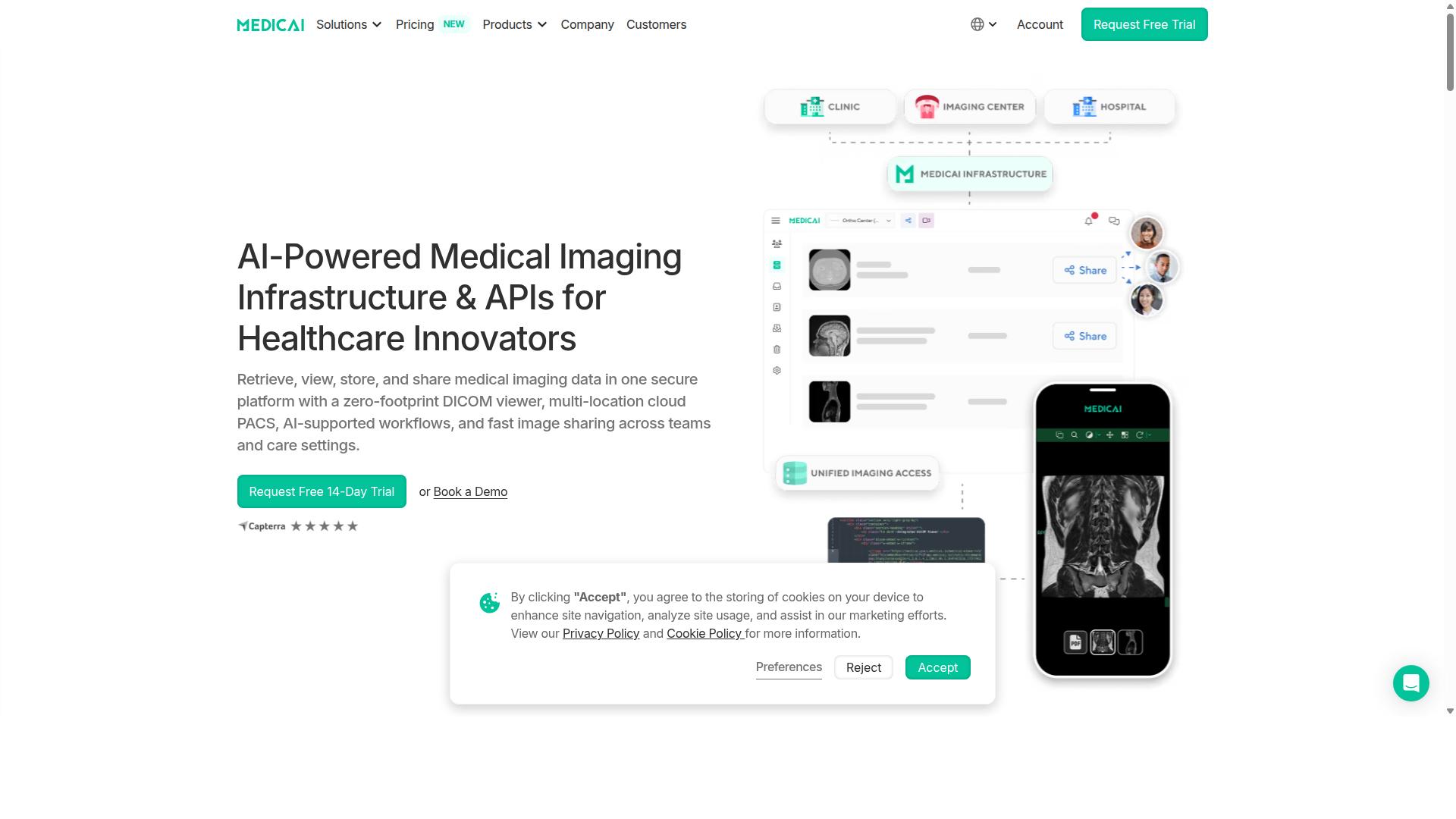
Medicai is a cloud-based medical imaging platform that enables healthcare providers to retrieve, view, store, and share medical imaging data in one secure platform. The platform centers on a zero-footprint DICOM viewer that removes the need for local software installation on user devices.
Traditional medical imaging systems often require lengthy installations and ongoing maintenance across multiple workstations. A zero-footprint approach allows authorized users to access images through any standard web browser without additional setup or configuration steps.
This design supports multi-location cloud PACS operations while maintaining compliance with healthcare data security standards. The platform serves healthcare providers across various care settings and team sizes.
Four core capabilities define the platform operation. The retrieve function pulls medical imaging data from connected sources into the system. The view function displays images through the browser-based DICOM viewer for immediate clinical review.
The store function maintains imaging data within the secure cloud infrastructure. The share function enables distribution of imaging data across teams and care settings with appropriate access controls.
These functions operate as part of Imaging Infrastructure as a Service that supports modern medical imaging workflows. The platform addresses interoperability needs between different healthcare systems and departments.
Why Medicai Is the Best Cloud-native Enterprise Imaging Platform
Cloud-native architecture delivers automatic scaling, global accessibility without hardware maintenance. This foundation supports enterprise medical imaging at scale while maintaining consistent performance across locations.
Containerization and Kubernetes clusters allow organizations to expand capacity as imaging volume increases. New nodes join the cluster automatically, distributing workload evenly without manual intervention from IT teams.
Zero-downtime updates happen through rolling deployments that replace containers one at a time. Users continue accessing studies and reports while background processes handle software changes seamlessly.
Multi-tenant isolation keeps each organization's data separate within shared infrastructure. Role-based access controls and dedicated namespaces ensure that radiology workflows remain private and compliant with requirements.
Enterprise imaging platforms built this way can also manage DICOM studies, PACS functions, and vendor-neutral archives without additional hardware investments. The architecture supports interoperability through FHIR, HL7, and REST API connections.
Security features include encryption at rest and in transit, audit logs for every access event, and support for SSO, SAML, and OAuth protocols. These measures align with HIPAA standards for healthcare environments.
Workflow automation reduces manual steps in modality worklist management, report generation, and EMR integration. Radiologists benefit from hanging protocols, annotation tools, and 3D reconstruction capabilities that operate consistently across the fleet.
Disaster recovery operates through geographic redundancy and automated failover processes. Data remains available even during regional outages, protecting both clinical operations and patient information.
Image compression methods preserve diagnostic quality while reducing storage requirements. Lossless techniques ensure that detail remains intact for accurate interpretation and long-term archival needs.
AI integration becomes practical when compute resources scale on demand. Machine learning models can process studies in parallel across available cluster capacity without dedicated infrastructure.
Latency stays low because containerized services deploy close to clinical sites. Global accessibility allows authorized users to review studies from any location with appropriate network connectivity.
These architectural patterns address the core requirements of enterprise imaging deployments. Organizations gain the flexibility to grow services while maintaining security, compliance, and operational continuity.
Key Features and What Makes Medicai Stand Out
The platform groups its capabilities into three functional areas that map directly to daily radiology and clinical workflows.
Each area combines tools that cut manual handoffs between systems. The result is shorter turnaround times from order entry to final report.
Because every module lives in the same cloud-native stack, data moves without repeated export and import steps. This design speeds diagnosis by keeping images, reports, and patient context in one place.
CONNECT & RETRIEVE: Medical Imaging Uploader, DICOM Gateway
Incoming studies from any modality are ingested through the DICOM Gateway and automatically reconciled via modality worklist queries.
The Medical Imaging Uploader accepts drag-and-drop uploads of files up to 2 GB per study. It also handles HL7 ORM messages and exposes REST API endpoints for scripted transfers.
These three entry points remove manual file sorting and naming. Staff spend less time on routing tasks and more time preparing the next exam.
STORE & MANAGE: Cloud PACS, Medical Image Exchange, Patient Case Management
Studies are deduplicated, compressed losslessly, and stored in a vendor-neutral archive that keeps data portable across future vendors.
Tiered storage policies move older exams to lower-cost tiers while retaining immediate access to recent studies. Retention rules follow clinical and regulatory needs without extra policies to manage.
The patient case timeline links prior exams to current encounters so radiologists see context without separate lookups. Medical Image Exchange moves studies between sites or providers without physical media.
ACCESS, VISUALIZE, COLLABORATE: Structured Reporting, Doctor and Patient Imaging Portals
Referring physicians and patients access curated imaging studies through role-specific portals that embed structured reporting templates.
Inside the portals, users can open 3D MIP and MPR views, apply voice-driven annotations, and load customizable hanging protocols. One-click PDF report export sends results to any HL7 FHIR endpoint.
Structured Reporting for Radiology, Doctor Imaging Portal, and Patient Imaging Portal each reduce the steps needed to review images and finalize documentation. The zero-footprint DICOM Viewer runs in any browser, eliminating workstation installs.
Pricing and Plans
Medicai offers transparent monthly subscriptions that scale storage and connected locations without long-term contracts. The platform provides clear pricing tiers designed for different sizes of medical imaging operations. Organizations can match their current needs without committing to lengthy agreements.
The Starter plan costs $249 per month and includes 500 GB of cloud storage. This tier supports unlimited user accounts with no connected locations included. Teams starting with cloud-native enterprise imaging can access core features during a 14-day trial without providing payment details.
The Standard plan costs $749 per month and provides 2 TB of cloud storage. This option includes unlimited user accounts plus one connected location. Organizations handling larger volumes of DICOM studies benefit from the expanded capacity and single-location connectivity.
Both plans offer yearly billing options with 15% savings. The Starter plan reduces to $209 monthly when paid annually, while the Standard plan becomes $639 monthly. A one-time $1,000 DICOM Gateway setup fee applies per location for connectivity needs.
Enterprise customers receive custom pricing based on specific storage requirements and multiple connected locations. Per-study pricing models are available for organizations with variable imaging volumes. The structure supports scalability from initial deployment through expanded radiology operations.
Trust Signals
Independent audits and real-world usage metrics demonstrate the platform's reliability and regulatory readiness.
Cloud-native enterprise imaging platforms must prove consistent performance across multiple dimensions. Medicai achieves this through documented compliance achievements and measurable operational scale.
Healthcare organizations evaluating imaging solutions need concrete evidence of security posture and system capacity. These trust signals help decision makers assess whether a platform can handle sensitive medical data while meeting institutional requirements.
Security and Compliance Certifications
The system is both HIPAA and GDPR compliant and cleared by FDA and CEE authorities for diagnostic use.
Medicai implements AES-256 encryption at rest and TLS 1.2+ in transit to protect medical imaging data throughout its lifecycle. These encryption standards meet current healthcare security requirements for protecting patient information.
Granular role-based access control allows administrators to define precise permissions for different user types. SSO integration through SAML 2.0 or OAuth 2.0 enables seamless authentication with existing hospital identity systems.
Immutable audit logs maintain a seven-year record of all system activities. This documentation supports regulatory inspections and internal compliance reviews without requiring additional configuration.
Platform Scale and Performance Metrics
More than one million studies are processed annually with sub-second image latency and 99.9 percent uptime SLA.
Medicai currently stores 1.7 million studies and handled 300,000 DICOM visualizations in the past year. These numbers reflect sustained platform usage across diverse clinical environments.
The system manages 50 million API transactions each year. This transaction volume indicates reliable interoperability with existing hospital systems and third-party applications.
Automated backup occurs across three geographically separate regions. This redundancy protects against data loss from regional outages while maintaining continuous access to imaging studies.
Who Should Use Medicai
Any healthcare provider that handles cross-site imaging workflows benefits from a cloud platform that removes on-premise infrastructure. Hospitals and imaging centers gain the freedom to access studies from any location without maintaining local servers. Specialty care providers integrate imaging directly into daily operations through cloud-native tools.
Orthopedics teams review fracture patterns and surgical plans across multiple facilities without physical film transport. Neurology practices examine brain and spine studies in real time during remote consultations. Oncology departments coordinate with tumor boards through shared access to longitudinal patient imaging.
Cardiology services monitor cardiac studies across satellite locations with consistent image quality. Ophthalmology clinics track retinal changes over time through secure cloud storage. Dental practices access panoramic and cone-beam CT scans for treatment planning without separate storage systems.
Gastroenterology units review endoscopic and fluoroscopic studies during multidisciplinary rounds. EMR and RIS integration eliminates duplicate scans by pulling prior studies into the current workflow automatically. Providers avoid repeating imaging procedures when complete records remain accessible across departments and locations.
Virtual care providers and telemedicine platforms connect imaging data with patient encounters through the same unified system. Teleradiology services deliver reports faster when images reside in a single cloud environment. Personal injury lawyers request specific studies without navigating multiple facility systems.
Clinical trials require standardized imaging protocols across research sites. Medical education organizations use de-identified cases for teaching without physical media distribution. The patient portal extends access to individuals who need their own imaging records for second opinions or care coordination.
Final Verdict
For hospitals and imaging centers seeking scalable, standards-based enterprise imaging without hardware overhead, Medicai offers a mature cloud alternative.
The platform delivers cloud-native architecture built for enterprise imaging needs. It handles DICOM workflows through zero-footprint access that eliminates local servers.
Standards support includes FHIR, HL7, and REST API connections. This approach enables interoperability across existing PACS, RIS, and EMR integration systems.
Scalability comes from microservices design and containerization that adapts to growing imaging volumes. Data security features encompass encryption, audit logs, and role-based access controls.
Deployment requires no hardware installation or ongoing maintenance. The service runs on Kubernetes infrastructure with built-in disaster recovery capabilities.
Contact Medicai USA at 7901 4th St N, STE 300, St. Petersburg, FL, 33702 or call +1 (832) 220 1035. The Romania office is located at 53-55 N Filipescu, 5th Floor, Sector 2, Bucharest, 020961 with phone +40 316 305 875. Email sales@medicai.org to schedule a personalized demo.